
Witika Business Proposal Analysis
Software Overview
Witika Business Proposal Analysis is a comprehensive desktop application for business planning, proposal development, financial modelling, risk analysis, accounting, and reporting. It is designed for entrepreneurs, investors, consultants, SMEs, startups, NGOs, corporate teams, development organizations, academics, students, and policy professionals.
The software enables users to prepare complete business proposals by integrating business information management, market analysis, product and service planning, marketing strategy, organizational and operations planning, financial projections, funding analysis, break-even analysis, sensitivity analysis, scenario analysis, Monte Carlo simulation, external factors analysis, general ledger accounting, and report generation into one system.
It is particularly suited to clients who need professional business proposals, investor pitch documents, feasibility studies, funding and loan applications, grant proposals, consultancy reports, or business expansion plans. Rather than working across separate Word documents, spreadsheets, accounting files, and charting tools, users work within one structured environment.

Value to Entrepreneurs and Startups
For entrepreneurs and startups, the software provides a step-by-step environment for turning a business idea into a structured proposal. Users can enter business details, define the problem being solved, articulate the value proposition, document objectives, describe products and services, identify target customers, analyse competitors, estimate revenues, calculate costs, assess funding needs, and generate proposal reports.
It supports startup expense planning, recurring expense tracking, monthly revenue estimation, product pricing, unit sales assumptions, variable cost estimation, use of funds, investor returns, and funding structure. This helps entrepreneurs assess whether a business idea is financially realistic before presenting it to investors, banks, partners, or grant providers.
The break-even analysis feature is especially valuable, showing how many units must be sold before costs are covered. Entrepreneurs can test changes in price, fixed costs, and variable costs to see how viability shifts under different assumptions.


Value to SMEs and Corporate Users
For SMEs, established businesses, consultants, and corporate teams, the software supports business expansion proposals, new product proposals, branch opening proposals, capital investment plans, internal project proposals, feasibility studies, and strategic planning documents.
Users can model revenue, expenses, profit and loss, cash flow, balance sheet projections, financial ratios, and investment metrics including net present value, internal rate of return, payback period, and return on investment.
Corporate users can compare best-case, expected-case, and worst-case scenarios for management decision-making, investment committees, board presentations, funding requests, and risk assessment.
The reporting module generates full business proposal reports, executive summaries, and financial reports, which can be edited, previewed, printed, exported to PDF, or exported to Word where supported.


Value to Academia
Witika Business Proposal Analysis is useful in academic institutions, particularly business schools, entrepreneurship programmes, economics departments, finance courses, management programmes, research methods courses, and innovation hubs.
Lecturers can use it to teach students how to structure business plans and proposals. Students can use it for coursework, capstone projects, feasibility studies, entrepreneurship assignments, and startup pitch documents.
The software provides practical exposure to business planning concepts such as market size, growth rate, target demographics, competitor analysis, market gaps, barriers to entry, pricing models, sales channels, customer acquisition, operational resources, staffing, financial projections, sensitivity analysis, and Monte Carlo simulation.
For academic researchers and consultants, it supports feasibility studies, SME research, entrepreneurship research, financial modelling demonstrations, and proposal preparation for funded projects.
Value to the Policy and Development Sector
For policy professionals, development agencies, NGOs, local government officers, business development service providers, and economic development organizations, the software supports entrepreneurship development, SME financing, project appraisal, cooperative business planning, grant application preparation, and investment readiness assessment.
It helps small businesses and community enterprises prepare structured business proposals for funding, loans, donor support, incubator programmes, and public-private partnership opportunities.
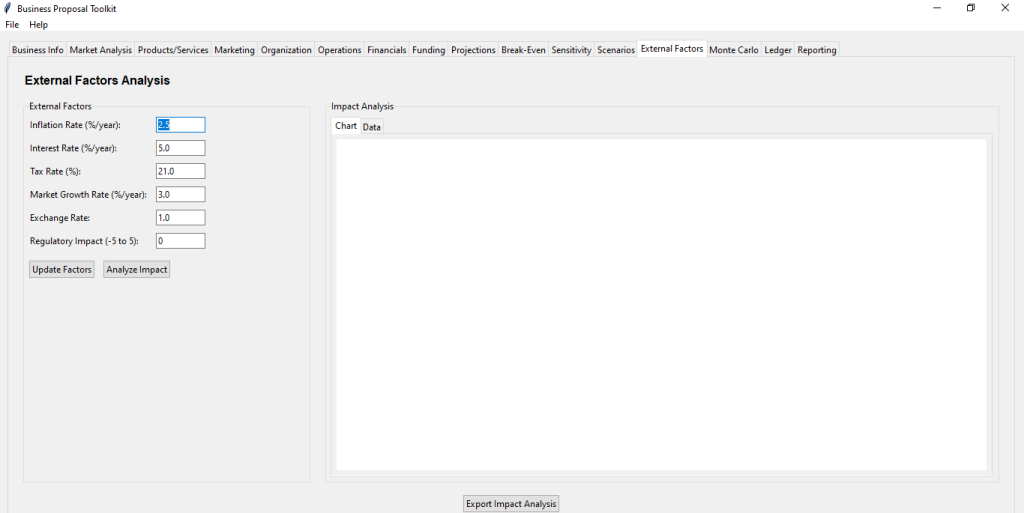
Policy analysts and development practitioners can examine how external factors such as inflation, interest rates, tax rates, market growth, exchange rates, and regulatory impacts affect business viability, which is useful for evaluating resilience under changing economic conditions.


Market Analysis Capabilities
The market analysis module allows users to document market size, annual growth rate, target demographics, industry trends, competitors, market gaps, opportunities, and barriers to entry.
Competitor analysis records competitor names, strengths, and weaknesses, helping clients understand the competitive environment and identify differentiation opportunities.
The market gaps and opportunities section helps users explain unmet customer needs, underserved segments, pricing gaps, service quality gaps, geographic gaps, innovation opportunities, or product availability gaps. These features strengthen proposals because investors and funders want evidence that the entrepreneur understands the market.
Product and Service Planning
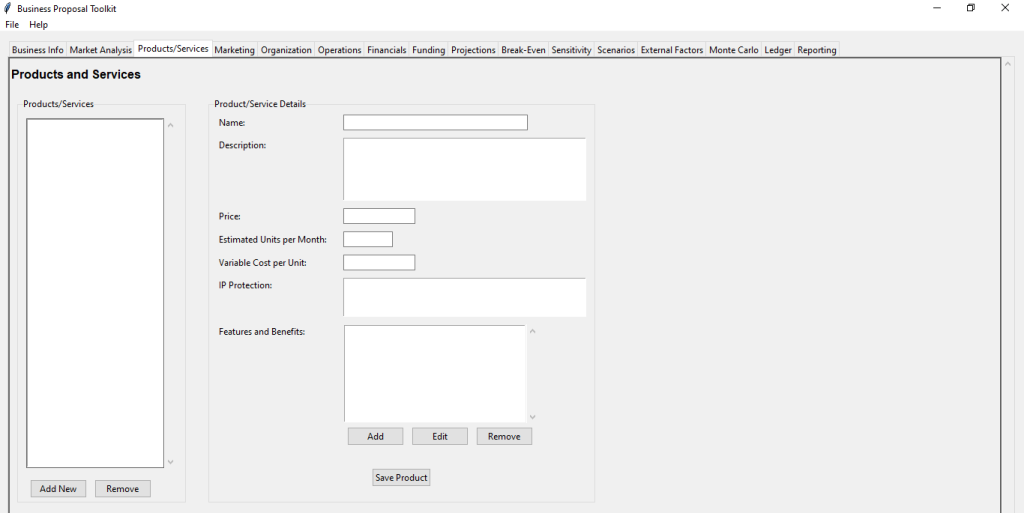
The product and service planning module allows users to create a list of products or services and define each in detail, including descriptions, prices, estimated units per month, variable cost per unit, intellectual property protection, and features or benefits.
This section links directly to financial planning, since prices, units, and variable costs feed into revenue projections, break-even analysis, and profitability calculations. Documenting features, benefits, and IP protection is useful for innovative businesses, technology startups, manufacturing ventures, agriculture businesses, service businesses, and creative enterprises.
Marketing Strategy Development
The marketing strategy module covers pricing strategy, promotion and advertising, sales channels, customer acquisition, and customer retention.
Users can define how they will reach customers, sell products or services, attract new customers, and retain existing ones. A strong proposal should show not only what the business sells but also how it will generate demand and sustain revenue.
Organizational and Operations Planning
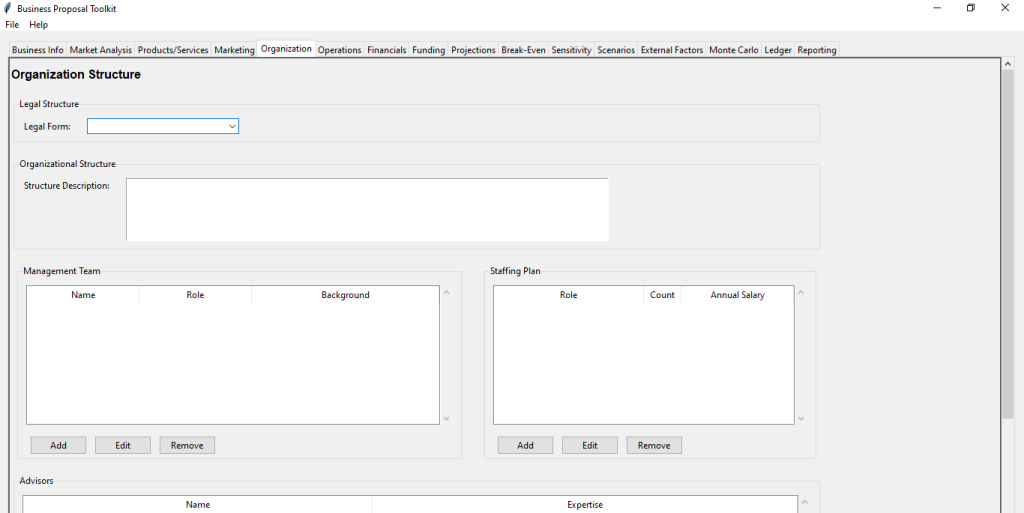
The organization module allows users to define the legal structure, organizational structure, management team, staffing plan, and advisors, demonstrating that the business has the people, structure, and governance to execute the plan.
The operations module allows users to describe business location, facilities, key milestones, required resources, key processes, and regulatory considerations, showing how the business will operate day to day. For funders and investors, this section is important because it connects the business idea to practical implementation.
Financial Planning and Projections
The financial planning module covers startup expenses, recurring expenses, revenue projections, funding requests, use of funds, and investor returns.
Users can enter startup costs, recurring monthly expenses, revenue sources, product prices, unit sales, and funding needs. The software then supports financial projections over a chosen horizon such as one, three, five, seven, or ten years.
Financial projections include revenue projections, expense projections, profit and loss projection, cash flow projection, balance sheet projection, financial ratios, and investment metrics. The investment metrics include net present value, internal rate of return, payback period, and return on investment, which help evaluate whether a proposed business or project is financially attractive.
Break-Even Analysis
The break-even analysis module calculates fixed costs, variable cost per unit, price per unit, contribution margin, contribution margin ratio, break-even units, and break-even revenue, helping users understand how much must be sold before the business becomes financially sustainable.
The software also includes what-if analysis, allowing users to test how changes in price, fixed costs, and variable costs affect the break-even point. Charts can visualize the break-even point, contribution margin, and profit at different sales levels.
Sensitivity Analysis
The sensitivity analysis module tests how changes in key variables affect financial outcomes. Variables include price, units, fixed costs, variable costs, inflation rate, interest rate, and tax rate. The software calculates the effect of these changes on net present value, internal rate of return, and annual profit.
Because business proposals often depend on assumptions, sensitivity analysis helps clients identify which assumptions matter most and where the business is most vulnerable.
Scenario Analysis
The scenario analysis module allows users to model best-case, expected-case, and worst-case outcomes by adjusting price, units, fixed costs, variable costs, inflation, interest rates, and tax rates for each scenario.
The software compares financial metrics across scenarios, including net present value, internal rate of return, return on investment, payback period, revenue, net income, and cash flow. This is valuable for risk planning, investor communication, loan applications, feasibility studies, and strategic decision-making.
External Factors Analysis
The external factors module covers inflation rate, interest rate, tax rate, market growth rate, exchange rate, and regulatory impact. Users can update these assumptions and analyse how they affect financial performance, which is especially useful where macroeconomic conditions significantly influence business viability. Results can be displayed in tables and charts and exported to Excel where supported.
Monte Carlo Risk Analysis
The Monte Carlo simulation module runs many simulations using random variations in key assumptions such as price, units, fixed costs, variable costs, inflation rate, interest rate, and tax rate.
It generates distributions for net present value, internal rate of return, and profit, and calculates statistics including mean, median, standard deviation, fifth percentile, ninety-fifth percentile, probability of negative NPV, probability of loss in year one, expected payback period, and risk-adjusted ROI. This feature suits more advanced users seeking to understand uncertainty and risk in business proposals.
General Ledger and Accounting Support
The general ledger module allows users to record transactions and track income and expenses using double-entry bookkeeping. Users can enter transaction date, description, category, amount, transaction type, and payment method, and the system generates ledger entries viewable by account.
A chart of accounts covers assets, liabilities, equity, income, and expenses. Users can manage accounts, view the chart of accounts, and export transactions and ledger records. This connects business planning with basic accounting records.
Reporting and Export Features
The reporting module generates full business proposal reports, executive summaries, financial reports, market analysis sections, and custom report sections.
Reports are generated in editable markdown-style text. Users can preview the report, insert charts, tables, and financial data, print reports, export to PDF, and export to Word where the required libraries are installed. Financial projections, sensitivity analysis, scenario analysis, external impact analysis, and Monte Carlo results can be exported to Excel where OpenPyXL is installed.
Key Features
Witika Business Proposal Analysis includes business information management, logo upload, mission, vision, problem statement, and value proposition sections, business objectives and long-term goals, market size and growth analysis, target demographics, industry trends, competitor analysis, market gaps and opportunities, barriers to entry, product and service planning, pricing and unit sales assumptions, variable cost tracking, marketing strategy development, customer acquisition and retention planning, organizational structure planning, management team and staffing plan, operations planning, milestones, resources, processes, and regulations, startup expense planning, recurring expense planning, revenue projections, funding request and use-of-funds planning, investor returns planning, financial projections, profit and loss statement, cash flow projection, balance sheet projection, financial ratios, investment metrics, break-even analysis, what-if analysis, sensitivity analysis, scenario analysis, external factors analysis, Monte Carlo simulation, general ledger and chart of accounts, transaction tracking, reporting tools, Excel export, PDF and Word export where supported, and logging for error tracking and troubleshooting.
Who Should Use Witika Business Proposal Analysis
Witika Business Proposal Analysis is suitable for entrepreneurs preparing business proposals, startups seeking investors, SMEs applying for loans or expansion funding, consultants preparing feasibility studies, business development service providers supporting clients, students preparing entrepreneurship assignments, lecturers teaching business planning and financial modelling, NGOs preparing income-generating project proposals, development agencies supporting SME development, government and policy institutions promoting entrepreneurship, corporate teams evaluating new projects, cooperatives preparing funding applications, and investors reviewing business assumptions.
Why Clients Should Choose This Software
Witika Business Proposal Analysis brings together proposal writing, business planning, financial modelling, risk analysis, accounting, and reporting in one place. It helps users move from idea to structured proposal, from assumptions to projections, and from projections to evidence-based decision-making.
The software is especially valuable because it does not only generate narrative reports. It also helps users test whether a business makes financial sense through break-even analysis, investment metrics, sensitivity analysis, scenario planning, and Monte Carlo simulation. This makes it useful for serious business planning, not just document preparation.
Trial and Subscription Information
Trying Witika Business Proposal Analysis is free of charge. Clients can run and test the software for free until the trial version expires. After the trial period, clients can decide whether to subscribe and continue using the software.
The subscription fee is K300 per month for Zambian clients and USD 50 per month for clients from foreign countries. Payment methods are open to discussion with each client because preferences vary. Clients may cancel their subscription at any time. Please subscribe to continue using the software after the trial version expires.
Subscription Assistance
For subscription assistance, contact Research Expert Solutions by email at resgroup@research-expert-solutions.com, or for a prompt response, call or send a WhatsApp message to +260 972 412 315.
We look forward to assisting you.